News
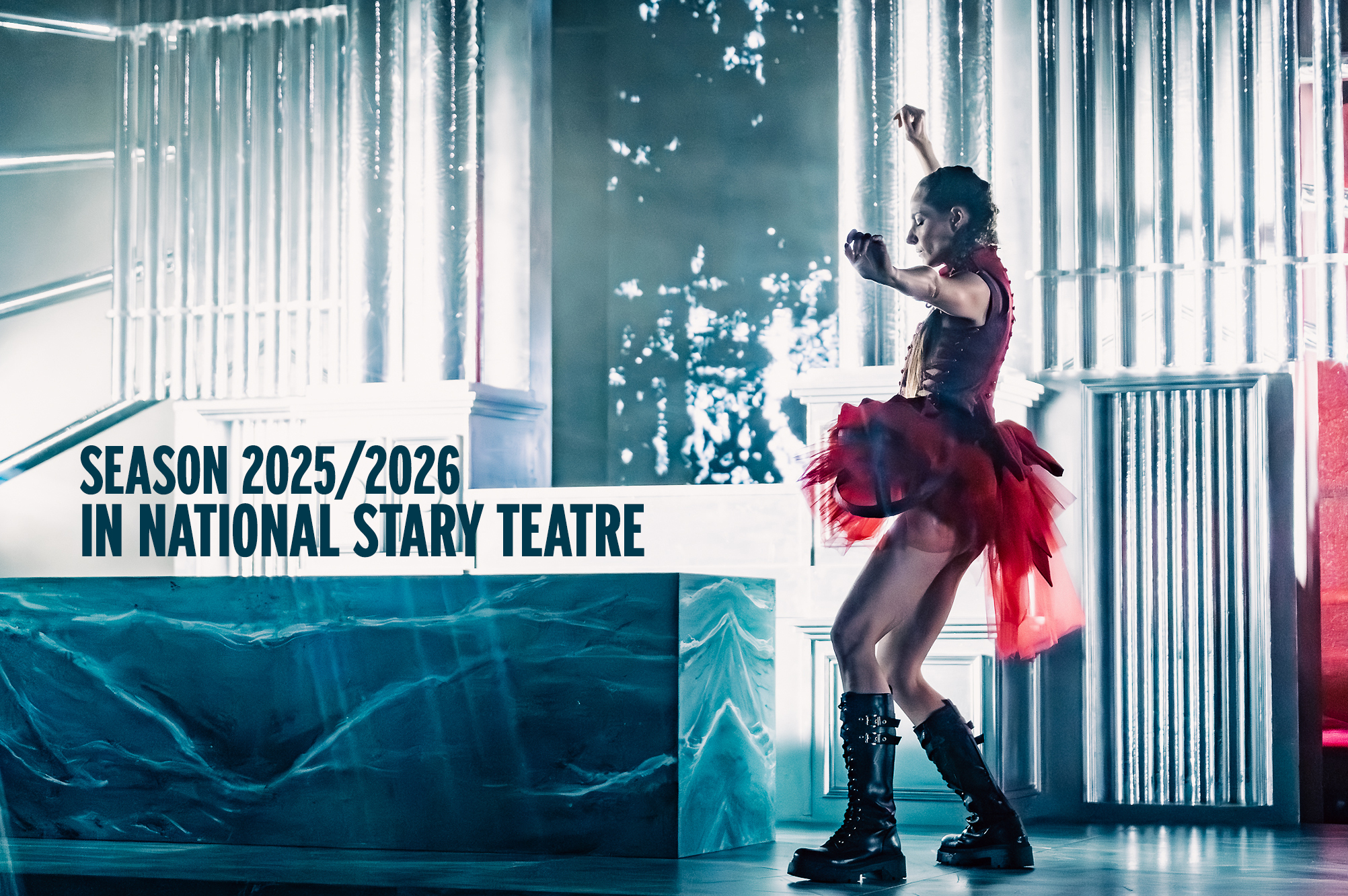
Season Summary – 2025/2026
The 2025/2026 season at the National Stary Theatre unfolded as a story about searching for one’s place in a world that is renegotiating the meaning of concepts such as responsibility, closeness, freedom, and belonging. It was a season built around the need to develop new languages of community, new ways of remembering, and new forms of hope.
・
The protagonists of the season’s premieres sought stability in what seemed most fundamental: family, childhood dreams, and relationships with others. They returned to familiar places and narratives—school reading lists, the experience of Poland’s political transformation, personal memories, and iconic works of culture—to ask what remains of these stories and whether they can still help us understand the present. The importance of these experiences was ultimately confirmed by our audiences: more than 78,200 spectators and participants attended performances and events at Kraków’s National Stary Theatre.
・
Memory played a central role throughout the season’s productions—a space of disputes, silences, and constant negotiation. In Still Lifes, Elsa Revcolevschi explored the traces left by history and the ways in which private experience intertwines with collective memory. In Close Your Eyes, Nel: In the Desert and the Wilderness—An Epilogue (semi-finalist of the Gdynia Drama Award, finalist of the 32nd National Competition for the Staging of Contemporary Polish Drama, and recipient of the Best Actress Award for Dorota Pomykała), Piotr Domalewski confronted family memories with the colonial fantasies embedded in Polish culture, demonstrating that the past is never a closed chapter. What appeared stable and unquestionable revealed itself instead as a construct requiring constant renewal and reinterpretation.
・
Another key theme was community—both the intimate community formed by friends establishing a school cooperative in The Bankruptcy of Little Jack, directed by Maciej Podstawny after Janusz Korczak’s novel, and the broader social community critically examined in Michał Borczuch’s The Pyramid of Animals (recipient of the Stanisław Wyspiański Theatre Award and the Radio Kraków Marek Award, finalist of the 32nd National Competition for the Staging of Contemporary Polish Drama, with the Best Actress Award for Małgorzata Zawadzka). The artists questioned whether solidarity is still possible in a reality shaped by competition, individual success, and economic efficiency. They returned to moments when community emerges through responsibility for others, while also exposing its fractures, exclusions, and inequalities.
・
The experience of loss resonated throughout the season: the loss of a father, a home, dreams, a sense of belonging, or faith in the political narratives that had long structured reality. In Close Your Eyes, Nel: In the Desert and the Wilderness—An Epilogue by Paweł Demirski, directed by Remigiusz Brzyk, the personal search for a father became the starting point for a reflection on the crisis of contemporary masculinity and the need to rebuild trust in society. Jakub Skrzywanek’s adaptation of Hubert Selby Jr.’s cult novel Requiem for a Dream portrayed the loss of the capacity to dream in a world driven by the endless production of desires, stimuli, and addictions. The characters sought to rebuild their lives amid the ruins of former narratives, constructing new stories of their own. Sometimes this journey led toward intimacy and reconciliation; more often, however, it revealed loneliness, anxiety, and the difficulty of finding meaning in a world undergoing constant transformation.
・
Yet this is not a story of helplessness. On the contrary, each premiere offered a thoughtful engagement with reality and an attempt to imagine new ways of being together. Theatre became a place where different experiences, languages, and perspectives could meet—a space in which people could collectively confront what hurts, divides, and unsettles us, while also discovering what still enables us to build relationships, create communities, and imagine the future.
・
International Programme
An important aspect of the season was the expansion of the theatre’s international artistic collaborations. François Chaignaud, Choy Ka Fai, and Philippe Quesne began work in Kraków on future projects. Their residencies were designed to establish long-term partnerships between a repertory theatre and artists working at the intersection of theatre, dance, and performance. The first outcomes of these collaborations will premiere in the upcoming season with productions by Choy Ka Fai and Philippe Quesne. The National Stary Theatre also rejoined the prestigious European theatre network MITOS21.
・
Education and Community Engagement
As in previous years, the season was accompanied by an extensive educational programme for children, young people, and adults. A special role was played by MICET – the Museum and Centre for Theatre Education, which celebrated its 10th anniversary during the 2025/2026 season. The interactive theatre museum organised workshops, theatre classes, guided tours, temporary exhibitions, and meetings with artists, giving audiences the opportunity to actively explore the process of creating theatrical productions.
・
The theatre also continued to develop its choreography programme. The season included movement workshops, Gaga People sessions, Silent Disco events, Ambient Night, Kids Rave, and activities designed to bring together diverse groups of participants. In this way, the theatre became not only a venue for performances but also a space for social interaction, participation, and the exchange of experiences.
・
Conferences and Public Debate
In spring 2026, the theatre hosted a prestigious international conference organised in partnership with Georgetown University and The Laboratory for Global Performance & Politics. The event brought together artists, researchers, and activists from around the world to reflect on the role of theatre as a tool for civic dialogue and social change.
・
The season’s premieres, international projects, educational initiatives, and performative programmes formed a polyphonic portrait of contemporary humanity living in an era of acceleration, uncertainty, and profound transformation. It was a season of questions posed without easy answers—about memory and forgetting, freedom and responsibility, closeness, solidarity, and the possibility of living together in an increasingly complex world. In this sense, the motto You Belong Here was not simply an invitation to the theatre, but an invitation to co-create a community: a space where different stories can resonate alongside one another, and where individual experience can meet the experiences of others.
See more
AMERICAN CULTURE UNDER PRESSURE
AMERICAN CULTURE UNDER PRESSURE | Art, Protest, and the Politics of Memory in the Age of Donald Trump
24-04-2026
Continue reading